
Elettra Sincrotrone Trieste is Italy’s third-generation synchrotron, perched above the Adriatic at Trieste. Running since the 1990s, it is the only synchrotron in the world that routinely serves users at two different electron energies, tuning itself for ultraviolet or for X-ray science as the experiment demands.
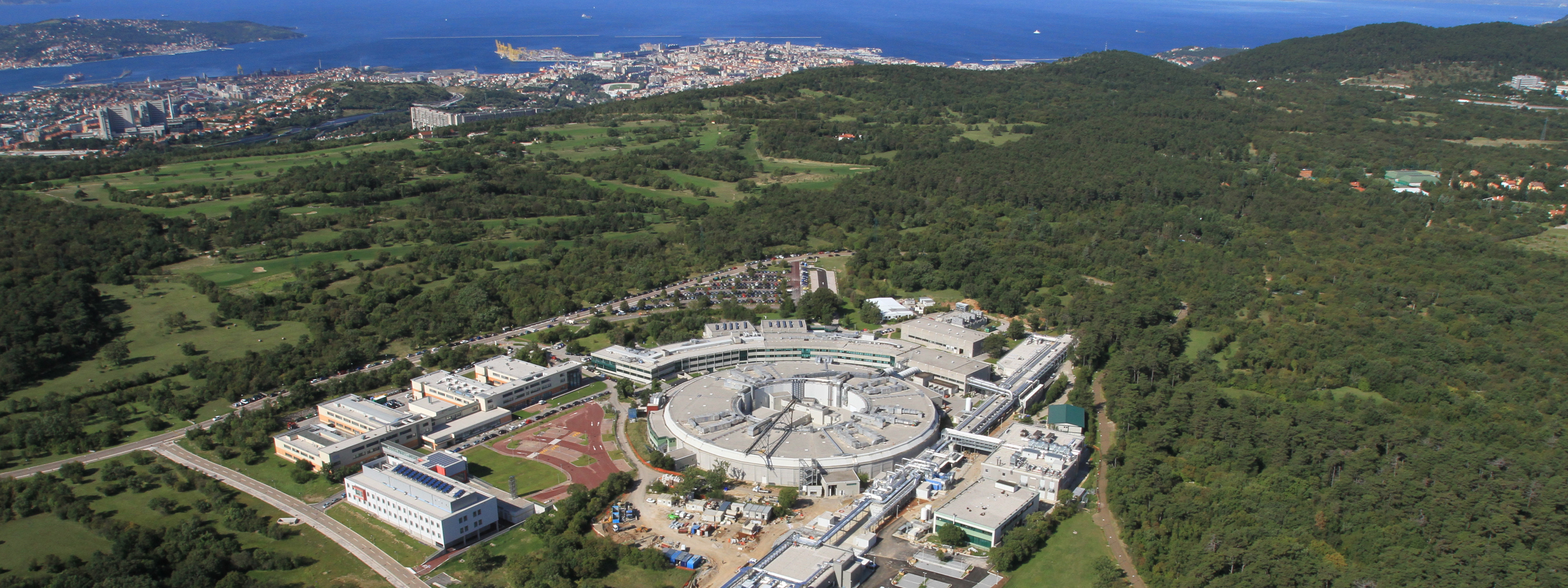
Elettra produces synchrotron light around ten billion times brighter than a conventional source and delivers it to experimental stations equipped for a wide range of analytical and processing techniques. Its defining feature is flexibility: the machine runs most of the time at 2.0 GeV, which favours extended-ultraviolet and spectroscopic work, and switches to 2.4 GeV for enhanced X-ray emission and diffraction. Since 2010 it has operated in top-up mode, keeping the beam current — and therefore the brightness — essentially constant throughout the day.
At a glanceFacility profile
- Location
- Trieste, Italy
- Operator
- Elettra Sincrotrone Trieste
- Type
- Third-generation synchrotron (dual-energy operation)
- Energy
- 2.0 GeV and 2.4 GeV
- Beam current
- 310 mA (2.0 GeV) / 150 mA (2.4 GeV)
- Beamlines
- 28 in operation
- First light
- 1994
- Website
- elettra.eu
The scienceWhat researchers do here
The light from Elettra supports an unusually broad community: physicists studying the electronic structure of quantum materials, chemists following reactions, biologists and life scientists imaging tissue, alongside work in environmental science, medicine, forensic science and cultural heritage. The two-energy mode lets a single facility cover both the soft-X-ray spectroscopy that probes electrons and the harder X-rays used for diffraction and imaging.
One ring, two energies — soft ultraviolet light for spectroscopy by day, harder X-rays for diffraction when the science calls for it.
Access for researchers
For Standard Access, Elettra issues two calls for proposals each year, with deadlines on 15 March and 15 September, each covering a six-month period. Additional access routes are described on the facility’s website.