
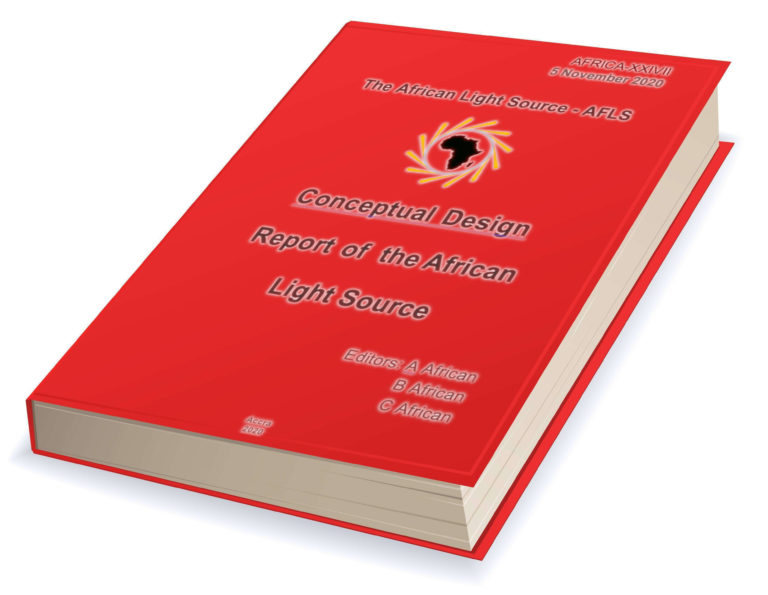
The Geopolitical Conceptual Design Report (G-CDR) is the single most significant document envisaged for the Roadmap of the African Light Source. It concretises every conversation with African governments, Pan-African organisations, and national and international partners — transforming the AfLS from a dream into a vision described in full detail.
The G-CDR initiative began at the AfLS2020 virtual event and was formally launched in December 2024 at the African Academy of Sciences (AAS) Conference in Abuja.
Why the CDR matters
For many large-scale multinational research infrastructures, the true “day zero” — the date from which the path to actual commissioning of the facility can be measured — is the date the Conceptual Design Report is completed. It marks the transition from an aspiration to a concrete, fully described vision: its motivation, its context, its purpose and its content.
PurposeIntroduction
The CDR is intended for a broad audience: policy makers, politicians, academics, engineers, technicians, business persons, industrialists, financiers and strategic thinkers, together with all possible stakeholders and stakeholder organisations — and, of course, the general public.
The CDR will not yet identify the site or the source of funds for the future AfLS facility. However, it will define the criteria for site selection, and it will include a reasonably accurate conception of what must be constructed — including all site preparation, supporting infrastructure and staff requirements. In doing so, the CDR enables and concretises the detailed conversations that must take place from the political level, through the scientific level, to the engineering, technical and financial levels.
MethodAn ubuntu process: by the community, for the community
The procedure for producing the CDR embodies the African concept of ubuntu: it is a document by the community for the community. The process is explicitly consultative, democratic and inclusive. Prof. Sekazi Mtingwa is the overall Editor of the CDR set of five volumes.

Prof. Sekazi Mtingwa
Overall Editor, AfLS CDR
Leads the editorial team responsible for the five-volume CDR and holds overall responsibility for its production.
Each volume of the CDR has its own Sub-editor. Each chapter, or sometimes each group of chapters, has its own set of Lead Authors. The Lead Authors play a dual role as Convenors: they cast the net wide, with an equitable geographic footprint, to solicit Letters of Interest (LoI), and they then arrange Town Hall Meetings — virtual, well-advertised and carefully planned Community Consultative Workshops (CCWs).
The CCWs are premised on the success of the call for LoIs. Reaching out to the community on a per-discipline basis, they invite all Africans to become Co-authors. Each Co-author, or group of Co-authors, submits an LoI before the workshop and may present it there as a short presentation. The LoIs and presentations define the research and science the community would like to do, or any other aspect of the CDR where they wish to contribute. The community then discusses each contribution in the context of similar or related presentations, and the Lead Authors facilitate collaboration among LoI Co-authors and groups of Co-authors who choose to accept it. Letters of Interest may also come from entire institutions.
Ultimately the Co-authors, as grouped by the Lead Authors, produce White Papers that motivate and describe their contributions. These White Papers are the final outcome emanating from the CDR Workshops, on a per-discipline basis, and they are peer reviewed. This step assures the Co-authors of recognition for their role in the CDR production process, and it establishes the full authorship of the CDR — including the Editor, Sub-editors, Lead Authors and Co-authors.
The AfLS will edit, arrange the review of, and produce a dedicated scientific Volume for publishing the White Papers. The particular journal is still under discussion, but it will be an African publication. Under the supervision of the Sub-editors, the Lead Authors then join the White Papers smoothly into the content of the volumes of the AfLS CDR. The CDR Editor holds overall responsibility for the CDR. The Editor and Sub-editors take the White Paper material, as processed by the Lead Authors, and retire together for several months in the context of an Institute of Advanced Study funded working visit.
Status
Writing of the CDR has begun and the call for Letters of Interest is out. The identification of the Editor, Sub-editors and Lead Authors is nearly complete, and the CDR is planned for completion. The process is managed in real time through a dedicated CERN-hosted Twiki, which records the call for LoIs and the ongoing progress of each volume.
WorkflowProcess summary
- Recruit Volume / Chapter / Section Lead Authors, together with Section Authors.
- Solicit Letters of Interest from individuals and organisations across the widest possible footprint in Africa, the Diaspora and the Friends of Africa.
- Hold Town Hall Meetings by chapter or volume as appropriate:
- presentations from the authors of the LoIs;
- arrange LoI authors into groups to write White Papers.
- Publish the White Papers in a peer-reviewed African science journal.
- Lead Authors and Authors for Volumes / Chapters / Sections draft the CDR section by section, based on the White Papers:
- Lead Authors for Volumes / Chapters / Sections also draft independently.
- Lead Authors of Volumes and the Editor finalise the CDR Volumes in a residential Advanced Study Institute model.
StructureThe CDR: five volumes
The CDR comprises five volumes under overall Editor Prof. Sekazi Mtingwa.
Volume I — Scientific, Socio-Economic, Educational and Political Benefits
Sub-editor: Marcus Newton
- Science Case
- Socio-Economic Benefits and Impact
- Educational Benefits / Human Capacity Building
- Enhancement of Governmental Policies
- Roadmap Forward
Volume II — Machine Design Concepts
- Lessons Learned from Global Advanced Light Sources
- Machine Components
- Other Facilities
Volume III — Scientific Capabilities and Beamline Technical Concepts
- Gamma-ray Spectroscopy and Crystallography
- Macromolecular X-ray (MX) Crystallography
- Materials and Chemical Crystallography
- Micro-crystallography
- Small / Wide-angle Scattering (SAXS / WAXS)
- Powder X-ray Diffraction (PXD)
- X-ray Spectroscopy (XAS / XES, XAFS, EXAFS, XANES, XFS, Auger)
- UV-vis, Electronic and Optical Spectroscopy
- Infrared Spectroscopy
- Pump-probe, Multi-colour and Time-resolved techniques
- Computed Micro- and Nano-Tomography
- Surface Microscopy and Imaging
- Beamlines for Medical Use
- Experimental Hutch Mechanical Systems
- Detectors and Electronics
- Data Handling, Algorithms, Software and Analysis
- Theory Centres
- Other Technical Capabilities for further instruments, fields of study and innovations
Volume IV — Technical Infrastructure and Building Design
Sub-editors: Simon Connell, Rudolf Dimper, Nathaniel Reed-Yehuda
- Site Selection Criteria
- Conceptual Design Specifications
- On-site User Support Facilities
- Computational Infrastructure
Volume V — Multinational Project Finance and Governance Concepts
Sub-editors: Jean-Pierre Ezin, Connie McNeely, Simon Connell, Aba Andam, Paul Woafo