
💊
Medicine & vaccines
Mapping the 3-D structure of proteins and viruses — the foundation of modern drug and vaccine design, including COVID-19 treatments.
It is one of the most powerful scientific instruments humanity has ever built: a ring, often the size of a stadium, that whips electrons to 99.9999% of the speed of light to create a beam of light billions of times brighter than the sun — light so intense it lets scientists see the individual atoms inside matter. This is how it works, and why Africa is building one.
A synchrotron light source is a giant machine that accelerates electrons to almost the speed of light and bends their path with powerful magnets. Every time the beam bends, it sheds an intensely bright beam of light — synchrotron light — spanning infrared through to hard X-rays. That light is piped to dozens of beamlines, where scientists use it as the ultimate microscope to study matter atom-by-atom.
Follow the electrons on their journey — from a hot wire to a beam of light. Tap any part of the machine to learn what it does.
The whole process, from a heated wire to a discovery, happens in a fraction of a second — and repeats billions of times a second.
An electron gun boils electrons off a hot cathode. A linear accelerator then uses radio-wave fields to push them to nearly the speed of light in just a few metres.
A booster ramps the electrons up to full energy and injects them into the storage ring, where magnets hold them on a circular path for hours, in an ultra-high vacuum.
Every time a magnet bends the beam — or an undulator wiggles it — the electrons radiate synchrotron light, from infrared all the way to hard X-rays.
Beamlines channel, filter and focus that light onto a sample. Detectors record how the matter responds — revealing its structure atom-by-atom.
Synchrotron light is not a single colour. It spans the spectrum from infrared to hard X-rays. Drag the slider to tune the beam and see what each kind of light lets scientists study.
Tuned to the energies of light elements like carbon, nitrogen and oxygen — ideal for studying chemistry, catalysts, magnetism and the surfaces of materials.
What makes a synchrotron special is not just the kind of light, but its brilliance — how many photons it packs into a tiny, sharply focused beam. The scale is almost unimaginable.
Brilliance compared on a logarithmic scale (photons per second, per area, per angle, in a narrow colour band). Each step up the chart is a leap of thousands to millions of times.
A single synchrotron serves chemistry, biology, medicine, physics, engineering, the environment and the arts. A few of the breakthroughs it makes possible:
Mapping the 3-D structure of proteins and viruses — the foundation of modern drug and vaccine design, including COVID-19 treatments.
Watching ions move inside a battery as it charges, to build longer-lasting, faster-charging and safer energy storage.
Designing stronger, lighter alloys, semiconductors and catalysts by seeing exactly how their atoms are arranged.
Tracing how plants take up nutrients and metals, to grow more resilient, nutritious crops on challenging soils.
Reading hidden layers of paintings, fossils and ancient artefacts without ever cutting them open.
Tracking pollutants and toxic metals at trace levels in soil, water and air — pinpointing where they come from.
Storage rings range from roughly a football pitch across to several city blocks around. The biggest are more than 800 metres in circumference, housed in a ring-shaped building you could jog laps around.
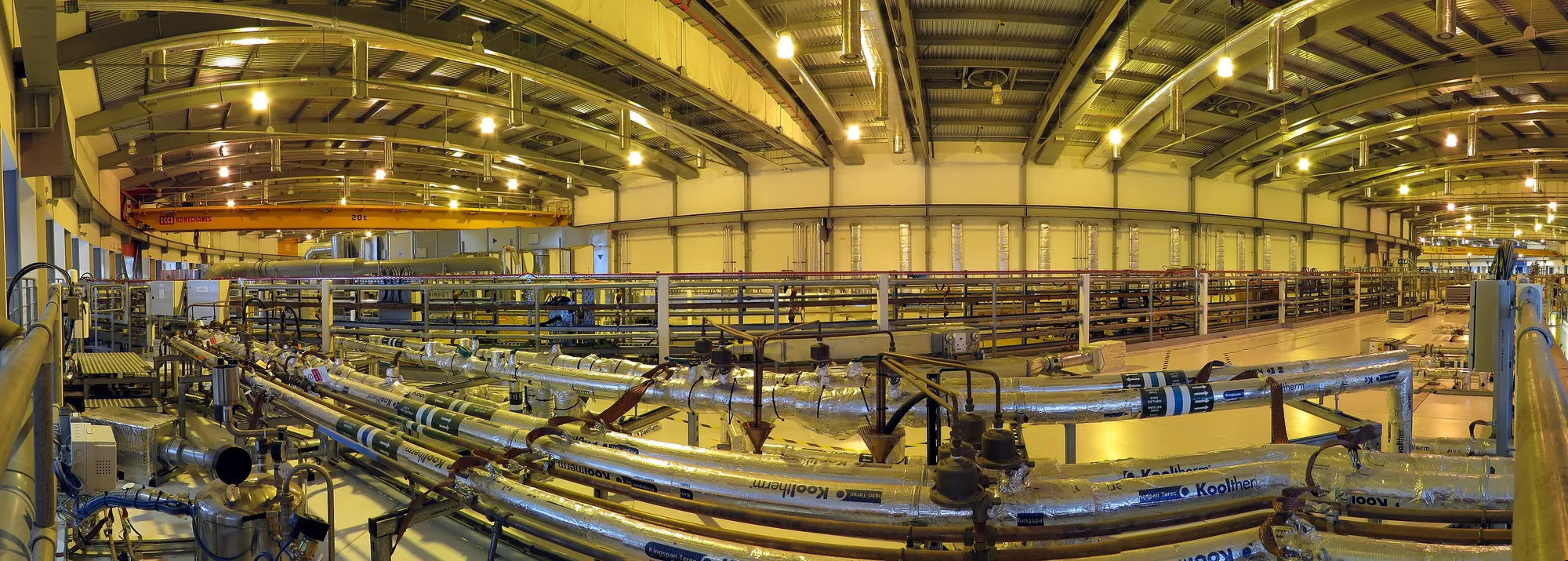
Today, African scientists who need synchrotron light must travel thousands of kilometres to Europe, Asia or North America to do their best work. The African Light Source initiative is changing that — building the people, partnerships and science case for an advanced light source on the continent, so that world-class research can happen in Africa, by Africans, for the world. If a coalition in the Middle East could build SESAME, Africa can build the AfLS.
They use the same family of light, but a synchrotron is millions of times brighter and far more precise. That brilliance is what lets it image single atoms and watch chemical reactions happen in real time — things a medical X-ray simply cannot do.
No. A synchrotron is not a nuclear reactor and produces no nuclear waste — it simply accelerates electrons. The radiation is fully contained behind thick shielding, and the machine switches off instantly. Thousands of scientists work safely at light sources every day.
Any electric charge that changes direction radiates energy. Because the electrons are travelling so close to the speed of light, that radiation is squeezed into an intensely bright, narrow, forward-pointing beam — the synchrotron light scientists use.
Once stored, a beam of electrons can circulate for many hours, looping the ring millions of times every second. RF cavities top up the energy they lose as light, and the beam is periodically refilled to keep the light steady.
Around 70 light sources operate across some two dozen countries — but none on the African continent. Building one is exactly the goal of the African Light Source initiative. See the roadmap →