Three young African scientists have travelled to the European Synchrotron Radiation Facility (ESRF) in Grenoble, France, to undergo deep training and conduct research in the engineering and use of modern advanced light sources — a tangible step on the roadmap to the African Light Source.
On 13 October, two students — Fortune Mokoena, an MSc candidate, and Alicia Potgieter, a PhD candidate — left Africa to train and perform research in the engineering aspects of advanced light sources, arriving at the ESRF the following morning. They followed closely on the heels of the third member of this trio, Kudakwashe Jakata, who left Africa on 18 September to take up a postdoctoral position focused on palaeontology.
The placements serve several connected goals: to build advanced human capacity in both the design and use of advanced light sources; to grow the user base of the African scientific community, for whom the world’s advanced light sources are premier multi-disciplinary research tools; and to work towards regional and even continental membership by Africa of the ESRF and other selected advanced light sources. Each of these is an important part of the roadmap to the African Light Source. In turn, these three emerging scientists will contribute to the excellence of both the ESRF and SESAME.
3African scientists at the ESRF
2countries of origin
3research fields: tomography, optics, palaeontology
MSC · TOMOGRAPHYFortune Mokoena

Fortune (Tebogo) Mokoena is a South African who began his MSc project on 1 May 2020, working remotely owing to the COVID-19 pandemic. His project is to participate in the design of the new phase-contrast tomography beamline (BEATS) of SESAME in Jordan — a multi-institutional project co-ordinated by the ESRF.
Phase-contrast tomography is seen as particularly interesting for the African Light Source project because of its significant contribution to the heritage and material sciences, especially given the rich palaeontological record in Africa. Fortune’s internship, supported by the ESRF, runs for one year. He is registered at the University of Johannesburg in South Africa, co-supervised by an ESRF staff member.
PHD · BEAMLINE OPTICSAlicia Potgieter

Alicia Potgieter is a South African who began her PhD project on 26 October 2020. Her work spans the theoretical and experimental aspects of designing, modelling and testing novel prototype cooling systems. The ESRF Extremely Brilliant Source (ESRF-EBS) represents a massive increase in light-source performance, and a correspondingly large increase in the beam power that the beam optical elements must sustain. These elements now require more advanced active cooling while meeting superior stability requirements.
The project immerses her in X-ray beamline optical processing and an array of modelling packages that allow the design and study of dynamical cooling solutions within sensitive mechanical equipment under extreme stability demands — a vital skill set for the future African Light Source. Alicia’s internship is supported by the ESRF for two to three years, and she is jointly registered at the University of Johannesburg and the Université Grenoble Alpes in France.
I am so grateful for this one-in-a-lifetime opportunity and to be part of one of the world’s leaders in synchrotron and X-ray research. I look forward to this life-changing experience which opens many doors of opportunity and possibilities.
POST DOC · PALAEONTOLOGYKudakwashe Jakata
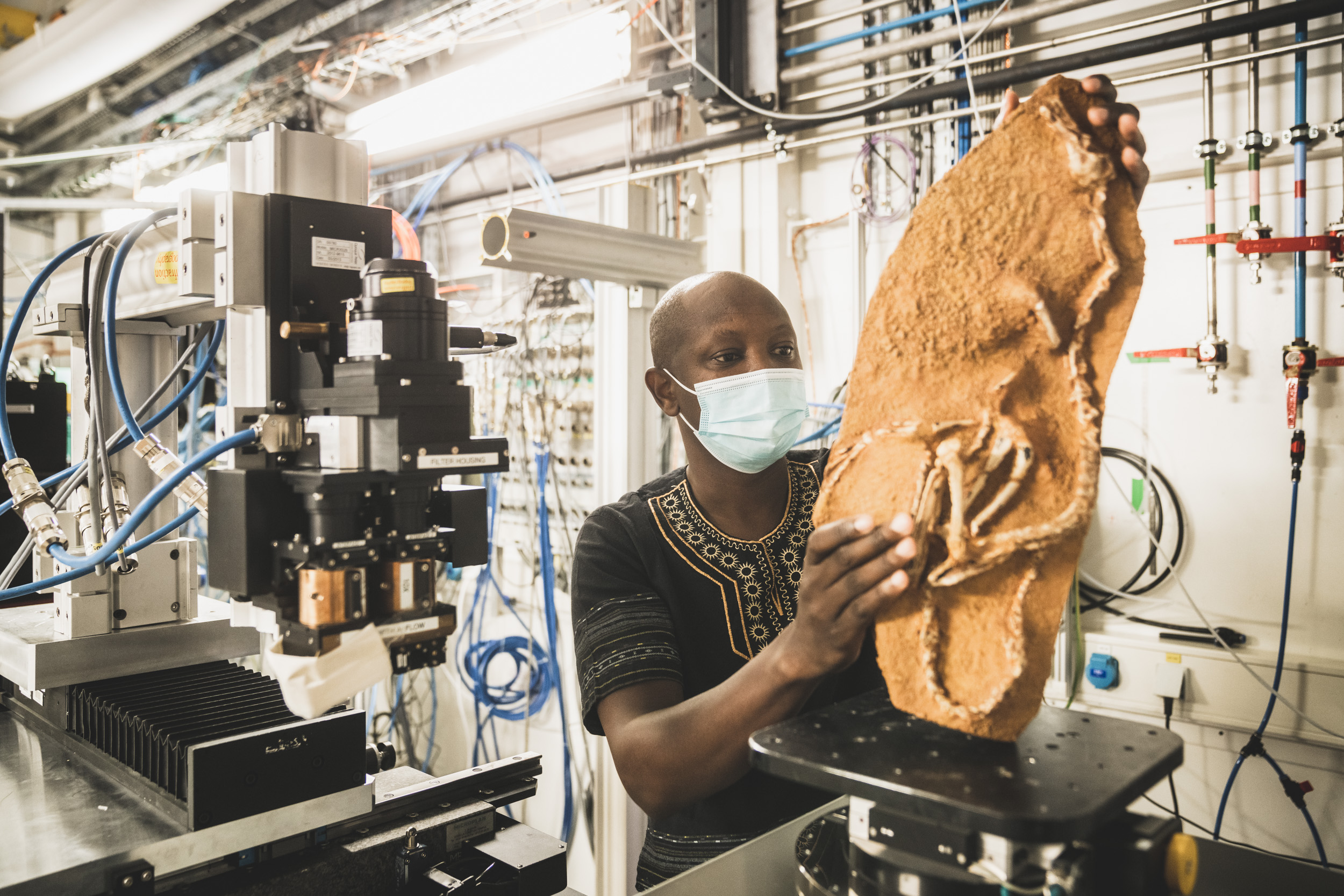
Kudakwashe Jakata is a Zimbabwean who began his postdoctoral fellowship at the ESRF on 18 September 2020 on the Computed Tomography beamline (ID19 and BM05), focusing on palaeontology. He is a physicist with an interdisciplinary character, crossing over into palaeontology. Having obtained his PhD in Physics, he managed the microtomography facilities of the Evolutionary Studies Institute at the University of the Witwatersrand in South Africa for some time, and has represented the palaeosciences within the South African synchrotron community for several years.
His postdoctoral position followed a LAAAMP FAST award, under which he is working at the ESRF on computed tomography and palaeontology. Kuda’s fellowship is supported by the ESRF for three years.
This is an excellent opportunity to learn from some of the best synchrotron scientists. All the knowledge and expertise obtained at the ESRF-EBS will, no doubt, be very useful for many years to come and especially for the African Light Source. I feel like a kid in a toy store and I am motivated to look beyond previous possibilities.
Why it matters
These placements grow Africa’s pool of scientists who can both design and use advanced light sources, expand the continental user base for premier multi-disciplinary research tools, and lay groundwork for regional or continental membership of the ESRF and other facilities — all milestones on the road to the African Light Source.