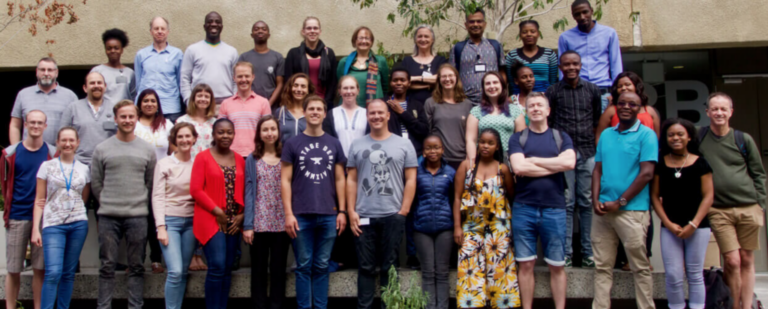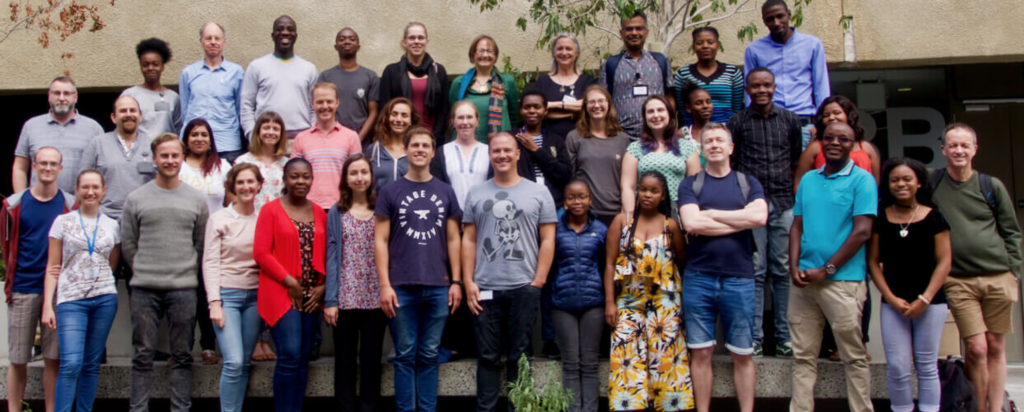
The Biophysics & Structural Biology at Synchrotrons workshop ran from 17–24 January 2019 in Cape Town, introducing young bioscience researchers to the power of synchrotron-based facilities and the techniques they enable.

- Dates
- 17–24 January 2019
- Location
- Cape Town, South Africa
- Audience
- Young bioscience researchers
- Format
- Theoretical and practical sessions
PURPOSEBuilding structural-biology skills in Africa
The aim of the workshop is to introduce young bioscience researchers to the power of synchrotron-based facilities. Through a combination of theoretical and practical sessions, bioscientists learn how to carry out molecular structure determinations — the foundation for vaccine design, drug discovery, industrial enzymology and agrochemicals.
HOW IT WORKSFrom beam to molecular structure
A synchrotron produces intense, finely focused X-ray light. When that beam strikes a crystallised biological sample, it scatters into a diffraction pattern that researchers use to reconstruct the three-dimensional structure of the molecule — revealing exactly how proteins, enzymes and other macromolecules are built and how they function.
APPLICATIONSWhat structure determination enables
VaccinesVaccine design
DrugsDrug discovery
EnzymesIndustrial enzymology
AgriAgrochemicals
Workshops like this one build the practical crystallography and structural-biology expertise that an African synchrotron community will depend on. They give early-career researchers hands-on experience with the methods that turn a synchrotron beam into new knowledge about the molecules of life.
Part of the Roadmap to the AfLS
This workshop is related to the START programme discussed elsewhere on this site, and forms another important part of the Roadmap to the African Light Source — growing the skilled user base that a future facility will serve.