
The Advanced Photon Source (APS), at Argonne National Laboratory near Chicago, is one of the world’s most powerful sources of high-energy X-rays — recently rebuilt as a fourth-generation light source serving thousands of researchers a year across the physical, life and environmental sciences.
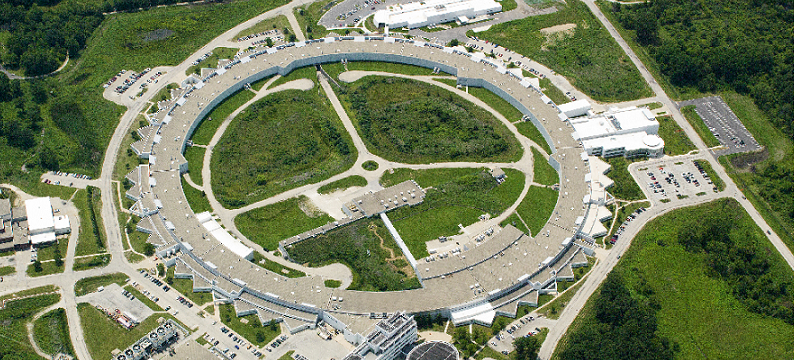
The APS produces intense, finely focused beams of hard X-rays — radiation energetic enough to penetrate dense materials and reveal the arrangement of atoms inside metals, minerals, batteries, catalysts and biological molecules. Operated for the United States Department of Energy’s Office of Science, it is an open user facility: scientists from universities, industry and government laboratories apply for beam time and travel to Argonne to run their experiments, at no charge for work they intend to publish.
At a glanceFacility profile
- Location
- Argonne, Illinois, USA
- Operator
- Argonne National Laboratory, for the US Department of Energy
- Type
- Fourth-generation synchrotron, optimised for hard X-rays
- Energy
- 7 GeV
- Circumference
- About 1,100 metres
- Beam current
- 100 mA
- Beamlines
- 68 in operation
- First light
- 1996
- Website
- aps.anl.gov
The scienceWhat researchers do here
Hard X-rays let scientists watch matter at the scale of atoms and as chemistry unfolds in real time — the way a battery electrode charges, how a catalyst grips a molecule, the strain inside an aero-engine alloy, or the folded shape of a protein that disease depends on. Because a single experiment hall hosts dozens of specialised beamlines, the APS supports an unusually broad sweep of research, from structural biology and pharmaceuticals to energy storage, geoscience and advanced manufacturing.
A national facility open to the world: scientists apply for time, then travel to Argonne to run experiments that no ordinary laboratory could support.
The next generationThe APS Upgrade
Between 2023 and 2024 the APS was rebuilt as a fourth-generation, diffraction-limited light source. A new multi-bend-achromat storage ring replaced the original lattice, concentrating the electron beam into a far smaller, more coherent spot and increasing X-ray brightness by up to several hundredfold. The completed upgrade keeps the facility at the frontier of hard X-ray science, opening new reach for high-resolution imaging and for studying complex, real-world materials.
Access for researchers
Beam time is awarded mainly through the General User Proposal system, reviewed on a regular cycle by independent panels and free for non-proprietary work intended for publication. Details and application forms are published on the facility’s website.