
FERMI, at Elettra Sincrotrone Trieste, is a seeded free-electron laser — a source of ultrashort, fully coherent pulses of extreme-ultraviolet and soft X-ray light, and one of the few facilities in the world built on the seeding principle.
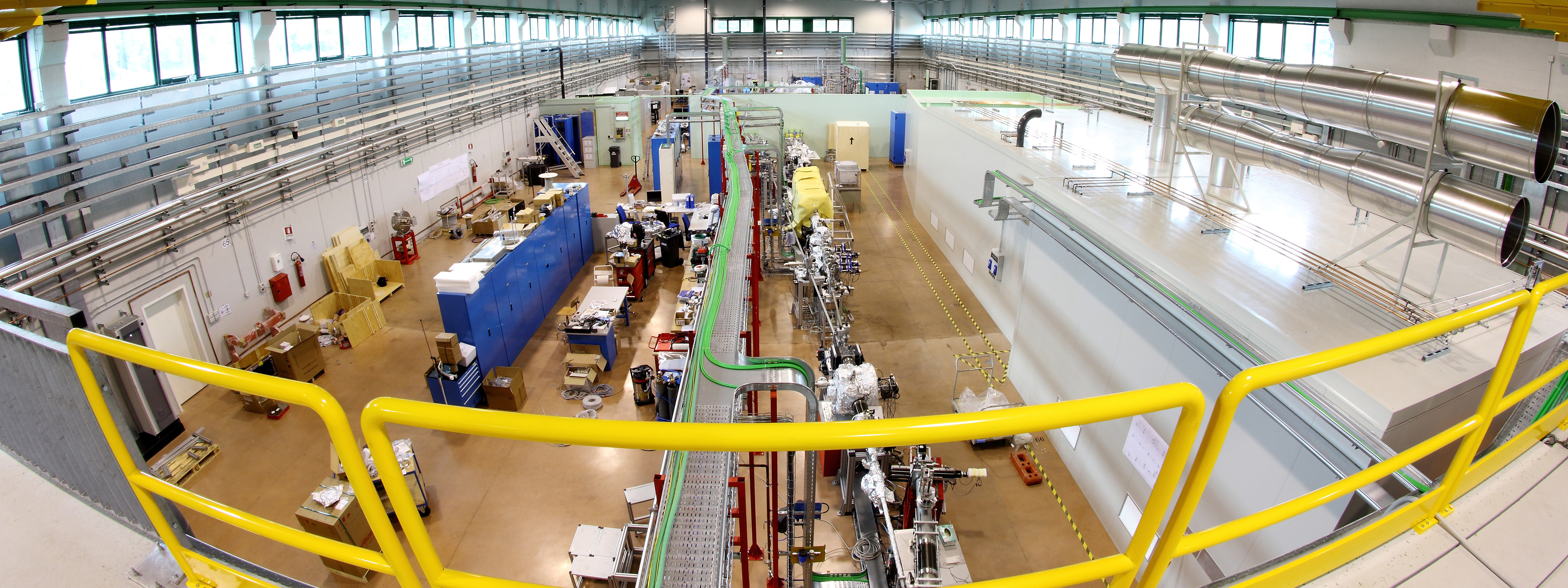
FERMI stands for Free Electron laser Radiation for Multidisciplinary Investigations. What sets it apart is its seeded design: instead of letting the laser pulse build up from noise, FERMI imprints it from a conventional seed laser, producing light that is highly coherent in both space and time and remarkably stable from shot to shot. Its APPLE-II undulators add full control of polarisation, from linear in any direction to circular, giving experimenters a precise, tunable tool.
At a glanceFacility profile
- Location
- Trieste, Italy
- Operator
- Elettra Sincrotrone Trieste
- Type
- Seeded free-electron laser (EUV to soft X-ray)
- Energy
- 1.5 GeV
- Wavelength
- 100 nm down to 4 nm (first harmonic)
- Beamlines
- 6
- Website
- elettra.eu
The scienceWhat researchers do here
The combination of coherence, controllable polarisation and femtosecond pulses makes FERMI a powerful instrument for ultrafast science. Researchers use it to follow chemical reactions and the dynamics of molecules in real time, to study magnetism and charge motion in condensed matter, and to explore problems spanning chemistry, physics, biology and advanced technology. A common shared seed laser keeps every part of the facility synchronised to femtosecond precision, which is essential for the pump-probe experiments at the heart of its programme.
Seeding turns a free-electron laser from a brilliant but noisy flash into a precise, repeatable instrument for watching matter move in femtoseconds.
Access for researchers
Access to FERMI’s beamlines is granted on scientific merit, assessed by an independent Proposal Review Panel of experts in free-electron-laser research. Calls for proposals are announced periodically through the facility’s user office.