
FLASH, at the DESY laboratory in Hamburg, was the world’s first free-electron laser to reach the soft X-ray range. Since 2005 it has delivered intense, ultrashort flashes of light to user experiments, and it now runs two beam lines in parallel.
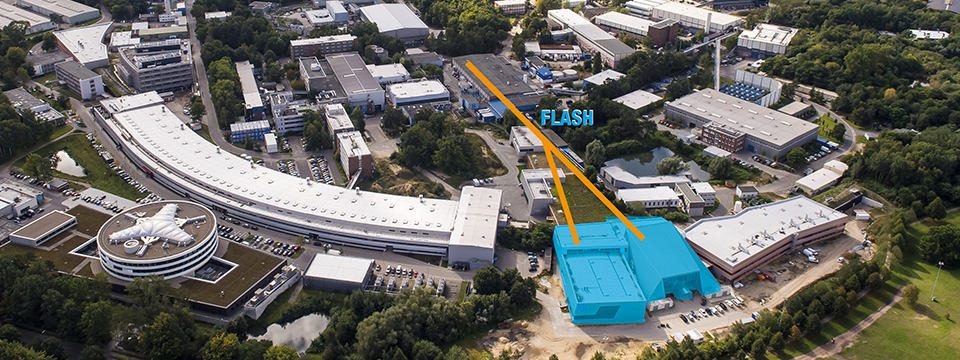
FLASH is a soft X-ray free-electron laser: it accelerates electrons and drives them through undulators to produce brilliant, coherent pulses lasting from a few femtoseconds to a couple of hundred. Two FEL lines operate at the same time with independent photon parameters, so different user experiments can run in parallel. As well as serving science directly, FLASH is a proving ground for new free-electron-laser methods and instrumentation.
At a glanceFacility profile
- Location
- Hamburg, Germany
- Operator
- Deutsches Elektronen-Synchrotron (DESY)
- Type
- Soft X-ray free-electron laser
- Energy
- 1.25 GeV (electron beam)
- Photon range
- ~15–300 eV
- Beamlines
- 2 FEL lines in operation
- First user light
- 2005
- Website
- photon-science.desy.de
The scienceWhat researchers do here
FLASH’s short, intense pulses make it especially suited to pump-probe experiments, in which one pulse sets a process in motion and a second captures what happens next on atomic timescales. Scientists use it to follow photocatalytic reactions, light-induced changes in conductivity and magnetisation, and other ultrafast dynamics. The facility supports research across health, energy, materials, earth and environmental science, and information technology.
The first free-electron laser to reach soft X-rays — and still a workshop for inventing the techniques the field will use next.
Access for researchers
For standard access, FLASH issues two calls for proposals each year, with deadlines on 1 April and 1 October, each covering a six-month period. Time is awarded on scientific merit through DESY’s user portal.