
The Photon Factory (PF), at the High Energy Accelerator Research Organization (KEK) in Tsukuba, Japan, is one of the country’s pioneering synchrotron light sources — the first dedicated X-ray synchrotron in Japan, still serving a broad community of materials and life scientists.
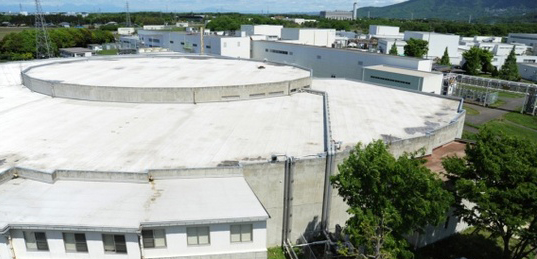
The Photon Factory operates two light-source accelerators. The 2.5 GeV PF ring has run since 1982 and, after a series of upgrades, is now a highly brilliant source of synchrotron X-rays. Alongside it, the PF Advanced Ring (PF-AR) is a high-intensity pulsed source well suited to time-resolved experiments. Together they support around forty experimental stations. The Photon Factory is part of the Institute of Materials Structure Science (IMSS), which uniquely combines four quantum beams — photons, neutrons, muons and positrons — on one campus.
At a glanceFacility profile
- Location
- Tsukuba, Ibaraki Prefecture, Japan
- Operator
- High Energy Accelerator Research Organization (KEK), Institute of Materials Structure Science
- Type
- Synchrotron light source (PF ring) with a pulsed advanced ring (PF-AR)
- Energy
- 2.5 GeV (PF) / 6.5 GeV (PF-AR)
- Beam current
- 450 mA (PF) / 60 mA (PF-AR)
- Beamlines
- Around 45, across roughly 40 experimental stations
- First light
- 1982
- Website
- www2.kek.jp/imss/pf/eng
The scienceWhat researchers do here
The Photon Factory reveals the atomic and electronic structure of materials of every kind, from crystals and thin films to proteins and other biological systems. Its beamlines support X-ray diffraction and scattering, spectroscopy, and imaging, underpinning research in condensed-matter physics, chemistry, structural biology and the earth sciences. The pulsed PF-AR adds the ability to capture fast processes as they happen, complementing the steady high brilliance of the main ring.
Japan’s first dedicated X-ray synchrotron, and still a versatile workhorse for the structure of matter — from quantum materials to the molecules of life.
Access for researchers
Proposal deadlines are set twice a year, in May and November, with certain categories accepted at any time. The Photon Factory welcomes applications from researchers worldwide, and beam time is awarded on scientific merit.