Excitement is growing within South Africa’s synchrotron light source user community — momentum that has been building for nearly two decades and that crystallised in a major strategic-planning workshop held in Pretoria in December 2011.
About this article
By Sekazi K. Mtingwa, of MIT and the African Laser Centre, and consultant to Brookhaven National Laboratory. Written January 30, 2012, and also published in the Spring 2012 Newsletter of the Forum on International Physics of the American Physical Society.
The WorkshopA two-day meeting to draft a national strategy
That excitement led to a two-day workshop, held December 1–2, 2011, in Pretoria to finalize plans for the drafting of a strategic plan document. The plan was to be submitted to the government’s Department of Science and Technology (DST), which is broadly responsible for science and technology in the country, and to the National Research Foundation (NRF), which is responsible for the distribution of research funding — similar to what the National Science Foundation does in the United States.
Top officials from those agencies attended the workshop, including Romilla Maharaj, NRF Executive Director of Human and Institutional Capacity Development; Rakeshnie Ramoutar, NRF Program Director of Strategic Platforms; and Takalani Nemaungani, DST Director of Global Projects. Daniel Adams, Chief Director for Emerging Research Areas & Infrastructure at the DST, provided funding for the workshop, and the South African Institute of Physics (SAIP) — which is similar to the American Physical Society — handled the logistics.
The entity that mainly drove the convening of the workshop was the Synchrotron Research Roadmap Implementation Committee (SRRIC), chaired by Tshepo Ntsoane of the South African Nuclear Energy Corporation (NECSA) and co-chaired by Wolf-Dieter Schubert of the University of the Western Cape.
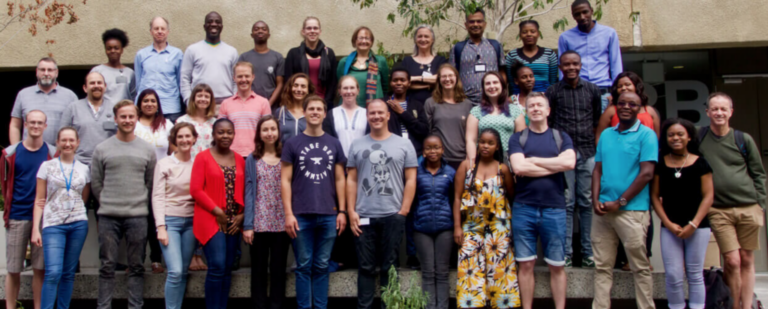
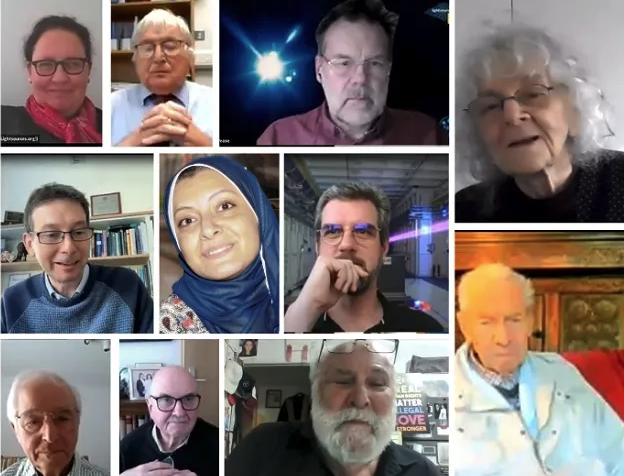
Approximately forty scientists attended the meeting, including delegates from international facilities. Herman Winick of SLAC and Sekazi Mtingwa of MIT attended in person, and Brookhaven National Laboratory’s Erik Johnson and Ken Evans-Lutterodt joined via teleconference. Johnson and Evans-Lutterodt discussed the pros and cons of South Africa’s inheriting Brookhaven’s second-generation light source, the National Synchrotron Light Source, which is soon to be replaced by NSLS II. The consensus of the workshop, however, was that a new third-generation facility would much better serve national and regional needs.
The largest contingent of foreign visitors came from the various European light sources, including José Baruchel, Jürgen Härtwig, and Laboratory Director General Francesco Sette from the European Synchrotron Radiation Facility (ESRF) in Grenoble, France; Jasper Plaisier from Elettra in Trieste, Italy; Trevor Rayment from Diamond in Oxfordshire, UK; and Hermann Franz from Petra III in Hamburg, Germany. Oxford University’s Angus Kirkland did an outstanding job of facilitating the two-day meeting.
- Dates
- December 1–2, 2011
- Location
- Pretoria, South Africa
- Convened by
- Synchrotron Research Roadmap Implementation Committee (SRRIC)
- Attendance
- Approximately 40 scientists, including international delegates
- Goal
- Finalize plans to draft a strategic plan for South African synchrotron science
OriginsSouth Africa’s first steps into synchrotron science
South Africa is relatively new to the international community of synchrotron light source users. Simon Connell, of the University of Johannesburg, has documented the history of South African scientists’ usage of synchrotron radiation. The first were Trevor Derry and Jacques Pierre Friederich “Friedel” Sellschop (deceased), both from the University of the Witwatersrand (Wits). In 1994, Derry performed studies of diamond surfaces at both the Synchrotron Radiation Source at Daresbury Laboratory and the ESRF. During the same year, Sellschop participated in other diamond studies at ESRF. Then in 1996, Giovanni Hearne, currently at the University of Johannesburg, used the ESRF to study materials under extreme pressures. Bryan Doyle, now also at the University of Johannesburg, served as a postdoctoral researcher at ESRF around 1999. From those early efforts, the synchrotron light source user community started to grow.
A synchrotron light source is a key single tool that could have wide impact across many scientific disciplines.
Hearne’s early experiences at ESRF so excited him that, upon returning to South Africa, he wrote a two-page letter to Khotso Mokhele, then President of the Foundation for Research Development (now the National Research Foundation). In it he shared those experiences and sought to impress upon Mokhele that a synchrotron light source is a key single tool capable of wide impact across many scientific disciplines. Hearne further suggested that a long-term goal should be for South Africa to construct its own light source via a consortium of international partners, especially involving neighbouring countries in Southern Africa.
RoadmapFrom idea to organised community: 1994–2012
A series of motivational papers, expert reviews and successive committees gradually built the case for synchrotron science in South Africa and turned a handful of pioneering users into a coherent national community.
In 2002, at the urging of the Edward Bouchet–Abdus Salam Institute (EBASI) — an organisation based at the International Centre for Theoretical Physics (ICTP) in Trieste that promotes African–African American collaborations — the African Laser Centre included the design and construction of a synchrotron light source as a long-term goal in its Strategy and Business Plan. Next, Tony Joel and Gabriel Nothnagel of NECSA co-authored a motivational paper, The South African Light Source: Proposal for a Feasibility Study for the Establishment of an African Synchrotron Radiation Facility (2003), followed by Tony Joel’s The South African Synchrotron Initiative: The South African Light Source: A Synchrotron for Africa – Strategic Plan (2004).
On another front, in 2004 the DST, NRF and SAIP commissioned an international panel of experts that released the report Shaping the Future of Physics in South Africa, which called for consideration of new flagship projects to complement those in astronomy — such as the South African Large Telescope (SALT) and the Square Kilometre Array (SKA). The panel used a synchrotron light source as a prime example of such a project. Key U.S. members of that panel were Ken Evans-Lutterodt, S. James Gates of the University of Maryland–College Park, and Guebre Tessema of the National Science Foundation.
The first organisational structure for a synchrotron science community took shape in 2003, when a committee of synchrotron users established the South African Synchrotron Initiative (SASI). Van Zyl de Villiers of NECSA played a key role in securing DST’s participation in SASI activities. The leadership of SASI mainly consisted of Tony Joel; Simon Connell; Giovanni Hearne; and Lowry Conradie, an accelerator physicist from South Africa’s national accelerator centre, iThemba LABS, located just outside Cape Town. As a result of its participation with SASI, in January 2005 the DST itself assumed a leading role in building the community by forming the Synchrotron Task Team (STT), with Tshepo Seekoe of the DST as Chair and Simon Connell leading the development of the science case. It was during this period that the synchrotron science community began to mobilise as a coherent group.
With the assistance of SOLEIL, ESRF and other organisations, the STT organised the first two of a series of roughly biennial Science @ Synchrotrons Conferences (S@S) in November 2005 and February 2007. Both conferences were extremely successful in developing new projects and sparking the interest of students in synchrotron light source training. Members of the U.S. physics community — including Herman Winick, Alfred Msezane of Clark Atlanta University, and Sekazi Mtingwa — participated in planning and giving presentations, helping to establish a close partnership between South African synchrotron users and their foreign colleagues, especially the French. After the second conference in 2007, the community further empowered itself with the establishment of SRRIC, which succeeded the STT in championing synchrotron science in South Africa. The first Chairs of SRRIC were Simon Connell and Giovanni Hearne. Following the S@S conference in February 2009, Brian Doyle assumed the Chair, followed by Tshepo Ntsoane.
Strategic PlanMission and next steps
All the above activities culminated in the excitement that birthed the December 2011 Strategic Plan Workshop. The NRF representatives requested that SRRIC document the outputs of the workshop by March 2012 in the form of a white-paper strategic plan. The NRF would then study the white paper to determine whether to give the go-ahead for the development of a detailed business plan by June 2012. Those dates were selected to coincide with the various stages of the government’s budgeting process. SRRIC appointed a three-person committee to write the strategic plan, consisting of Brian Masara, Executive Officer of SAIP; Douglas Sanyahumbi, Director of the Technology Transfer Office at the University of the Western Cape; and Sekazi Mtingwa, who chaired the committee.
Although the strategic plan has not been completed, some overarching comments can be made. First, there is widespread agreement on the mission of SRRIC going forward:
The mission of SRRIC
To support and facilitate the development and growth of synchrotron science in South Africa, so that it contributes to excellence in science, innovation and industrial development by exploiting the benefits of synchrotron radiation in advancing fundamental and applied science.
That mission is to be pursued through four lines of effort:
- Developing human capital — including attracting back the African scientific diaspora (brain gain) and mitigating any threat of brain drain among young South Africans who have recognised synchrotron science as a key research tool for their career development;
- Developing key and/or strategic international collaborations;
- Ensuring financial support to South Africans whose proposals successfully compete for beam-time at international synchrotron facilities; and
- Promoting awareness and use of synchrotron science and its capacity to enable the exploration of new frontiers of technology.
In pursuing this mission, the synchrotron science community and the government must undertake a number of key initiatives:
- Deciding at what level to formalise relationships with foreign light source facilities, especially with ESRF, which is the most heavily used by South African researchers. (Francesco Sette invited South Africa to join ESRF as a Scientific Associate at the 1% level, since its researchers’ utilisation of that facility is already approximately at that level.)
- Studying the feasibility of constructing South African or multinational beam-lines at foreign synchrotron facilities;
- Promoting significant growth in the number of synchrotron users, with heavy emphasis on increasing the number of students being trained — such as at the many synchrotron radiation schools offered at international facilities and institutions like ICTP;
- Developing programmes to preserve and expand existing technical expertise, such as sending scientists and engineers abroad to join accelerator teams and build capabilities in areas like ultra-high-vacuum systems, radiofrequency cavities, magnets, power supplies, and controls;
- Improving the local, critical feeder infrastructure that allows researchers to prepare and analyse samples before and after shipping them for studies at foreign synchrotron facilities;
- Promoting greater involvement of industrial users;
- Studying the feasibility of constructing a third-generation light source; and
- Developing mechanisms to educate the public about the revolutions in science and technology — such as the discovery of new pharmaceuticals — that synchrotrons afford.
Usage DataA growing user community
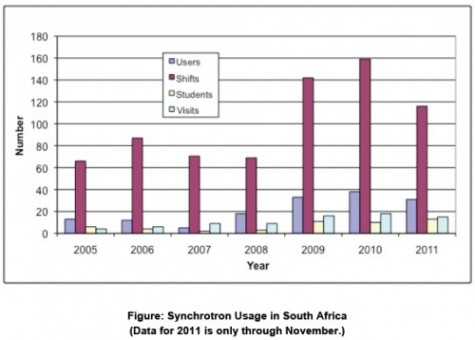
The figure below plots South Africa’s synchrotron light source usage in terms of the number of users, beam-line shifts, graduate students trained, and visits to synchrotron facilities. The data represent a rough approximation based on preliminary surveys; note that the 2011 data cover only part of the year, since 2011 had not ended by the time of the workshop. According to the data, the number of students trained at foreign facilities increased from six in 2005 to thirteen in 2011, showing growth in human capital, especially over the preceding three years. Long distances and substantial travel expenses are major factors that impede further increases in the number of students being trained — a need that a local facility would be most advantageous in addressing.

ApplicationsFrom fossils to fuels
Among the workshop presentations, two were especially notable for involving applications of synchrotron techniques to disciplines many people do not associate with the field.
Paleontology
Kristian Carlson of Wits discussed his collaboration with Lee Berger, also of Wits, and Paul Tafforeau of ESRF. Among other things, they perform dating and craniodental investigations of the possible human ancestor Australopithecus sediba — the much-publicised fossil remains that Berger’s nine-year-old son, Matthew, discovered in 2008 while assisting his father in field work.
Heritage science
Leon “Jake” Jacobson of the McGregor Museum (Kimberley) discussed his applications of light sources to study rock art — ancient paintings on stones. He investigates such issues as the composition of the paints and how their interactions with rock substrates contribute to the art’s conservation. There is increasing worldwide interest in the use of synchrotron radiation in art and archaeology.
Industry was represented too. Esna du Plessis and Bruce Anderson attended the workshop on behalf of the oil and gas company Sasol Technology. They reported on their use of synchrotron radiation in pursuing extended X-ray absorption fine structure (EXAFS) techniques to study H₂, CO and synthetic-gas activation of nano iron, and they made a strong case for a local source to enable more industrial use of light sources.
OutlookMomentum building rapidly
In conclusion, the momentum is building rapidly within the South African synchrotron science community. SRRIC, as its representative, is committed to maintaining — and indeed intensifying — that momentum. Based upon the Strategic Plan that summarises the outputs of the December 2011 workshop, SRRIC is looking forward to a favourable decision from DST and NRF requesting it to proceed to the development of a detailed Business Plan by June 2012, in order to move synchrotron science in South Africa to the next level of international prominence.